Showing posts with label History. Show all posts

Wednesday, May 16, 2012

Rape of Nanjing - The 1937 Nanjing Massacre by Japanese Soldiers

I have just finished reading this powerful book - The Rape of Nanjing. It has some of the most gruesome photos, which aims to describe 2 discrete atrocities by Japanese soldiers in the Rape of Nanjing. Firstly, how Japanese soldiers killed over 350,000 Chinese victims with maximum pain and humiliation in just 6 weeks. Secondly, the big cover up - the Japanese government tried to erase the entire massacre from public consciousness both at home and abroad.


Till today the Japanese have not owned up to this, leaving blank spaces of this Rape of Nanjing in their history books. George Santayana's immortal warning comes to mind - Those who cannot remember the past are condemned to repeat it.


The author Iris Chang researched the subject meticulously. Indeed, it provides a gripping and gruesome account of one of history's most brutal massacres. The mass butchery, rapes, murder, torture, killing contests by the Japanese soldiers, death by fire, mutilation, death by ice, death by dogs etc were unheard of. 


Read Wikipedia's account of it. Another source of historical document and photographs of the massacre is found here. (Nanjing Massacre: 300,000 Chinese People Killed, 20,000 Women Raped ...). And the website of Nanjing 1937 also give a lot of information on the incident.


Here is a documentary on youtube, by Rhawn Joseph, is based on 20 years research and consists entirely of archival photos and film-clips. This film begins with an overview of Japan and China at the beginning of the 20th Century, explains the mind-set of the Japanese and their God, Hirohito, and then continues with the invasion of China, the crimes committed by the Japanese (during the Fall) on the road to Nanjing, Nanjing Massacre, the rape of the Philipines, Unit 731, the Baatan death camps, Japanese denials, and the dropping of the A-bomb on Japan. 


And part 2 is below.


If you are in Nanjing visit The Memorial Hall for Compatriots killed in the Nanjing Massacre by Japanese Forces of Aggression. It is located in the southwestern corner of Nanjing known as Jiangdongmen, which used to be one of the execution grounds and mass burial places of the cruel holocaust.


The memorial consists of three parts: the outdoor exhibits, the remaining bones of the killed and the museum for historical material displaying. In the outdoor sector, group sculptures, full-length statues, relief carvings, signboards, monuments, redeeming and repentant tablets, withered trees and broken walls as well as a wall carved with the names of part of the victims so far that have been located cluster together with green shrubs and lawns to suggest a graveyard-style architecture with the themes of life and death, grief and indignation.


An exhibition inside the memorial hall to the victims in Nanjing massacre


A building shaped like a coffin is to shelter some of the victims' bones excavated from the pits of thousands of bodies right in the site when the memorial was in construction-an iron evidence for the bloody crimes committed by the aggressive Japanese troops. The museum lies half buried in the ground like a colossal tomb. Inside, an immense collection of pictures, objects, charts and photographs relate the horror of the Rape of Nanjing. Through a versatility of means for exhibitions such as lighted cabinets, sand trays, clay moldings, oil paintings, micro-computers appliances, documentary shows and so on, the tragedy of the cruel holocaust in Nanjing and the beastly atrocities of the Japanese militarists are pictured and recounted.


Fortunately, even in such dark times, there was a small band of Europeans and Americans who risked their lives to defy the Japanese invaders and rescue hundreds of thousands of Chinese refugees from almost certain extermination. These courageous men and women created the International Committee for the Nanking Safety Zone. Read about it here and here too with some pictures.


The author, Iris Chang (張純如), before her untimely death in 2004, was one of America's leading young historians. Her last, widely-acclaimed book focused on Chinese immigrants and t heir descendents in the United States — their sacrifices, their achievements and their contributions to the fabric of American culture, an epic journey spanning more than 150 years. But even before the publication of "The Chinese in America: A Narrative History," Chang had established herself as an invaluable source of information about Asia, human rights, and Asian American history.


I gained much from reading the book and when you stumble upon it, I hope you will read it and glean from it the many lessons about human nature.


Monday, January 2, 2012

The Great Dictator speech

I came across this great speech by accident. The Great Dictator Speech that was made by Charlie Chaplin in 1940 in the film The Great Dictator, and it a favorite speech of all time of many people. It's amazing after over 70 years how much of this is what we live with today.

Charlie Chaplin is said to have added his 4 1/2 minute final speech to The Great Dictator (1940) only after Hitler’s invasion of France. The speech both showcases the actor’s considerable dramatic gifts and makes a prescient, eloquent plea for human decency.


The speech is given below:


" I'm sorry but I don't want to be an Emperor, that's not my business. I don't want to rule or conquer anyone. I should like to help everyone if possible, Jew, gentile, black man, white. We all want to help one another, human beings are like that. We all want to live by each other's happiness, not by each other's misery. We don't want to hate and despise one another. In this world there is room for everyone and the earth is rich and can provide for everyone.
The way of life can be free and beautiful. But we have lost the way.


Greed has poisoned men's souls, has barricaded the world with hate;
has goose-stepped us into misery and bloodshed.


We have developed speed but we have shut ourselves in:
machinery that gives abundance has left us in want.
Our knowledge has made us cynical,
our cleverness hard and unkind.
We think too much and feel too little:
More than machinery we need humanity;
More than cleverness we need kindness and gentleness.


Without these qualities, life will be violent and all will be lost.


The aeroplane and the radio have brought us closer together. The very nature of these inventions cries out for the goodness in men, cries out for universal brotherhood for the unity of us all. Even now my voice is reaching millions throughout the world, millions of despairing men, women and little children, victims of a system that makes men torture and imprison innocent people. To those who can hear me I say "Do not despair".


The misery that is now upon us is but the passing of greed, the bitterness of men who fear the way of human progress: the hate of men will pass and dictators die and the power they took from the people, will return to the people and so long as men die [now] liberty will never perish. . .


Soldiers: don't give yourselves to brutes, men who despise you and enslave you, who regiment your lives, tell you what to do, what to think and what to feel, who drill you, diet you, treat you as cattle, as cannon fodder.


Don't give yourselves to these unnatural men, machine men, with machine minds and machine hearts. You are not machines. You are not cattle. You are men. You have the love of humanity in your hearts. You don't hate, only the unloved hate. Only the unloved and the unnatural. Soldiers: don't fight for slavery, fight for liberty.


In the seventeenth chapter of Saint Luke it is written:
"The kingdom of God is within man"
Not one man, nor a group of men, but in all men; in you, the people.


You the people have the power, the power to create machines, the power to create happiness. You the people have the power to make life free and beautiful, to make this life a wonderful adventure. Then in the name of democracy let's use that power, let us all unite. Let us fight for a new world, a decent world that will give men a chance to work, that will give you the future and old age and security. By the promise of these things, brutes have risen to power, but they lie. They do not fulfil their promise, they never will. Dictators free themselves but they enslave the people. Now let us fight to fulfil that promise. Let us fight to free the world, to do away with national barriers, do away with greed, with hate and intolerance. Let us fight for a world of reason, a world where science and progress will lead to all men's happiness.


Soldiers! In the name of democracy, let us all unite!


. . .


Look up! Look up! The clouds are lifting, the sun is breaking through. We are coming out of the darkness into the light. We are coming into a new world. A kind new world where men will rise above their hate and brutality.


The soul of man has been given wings, and at last he is beginning to fly. He is flying into the rainbow, into the light of hope, into the future, that glorious future that belongs to you, to me and to all of us. Look up. Look up."

If you are interested, you can actually watch the movie The Great Dictator here.

Sunday, January 1, 2012

2011 - The Year in Review

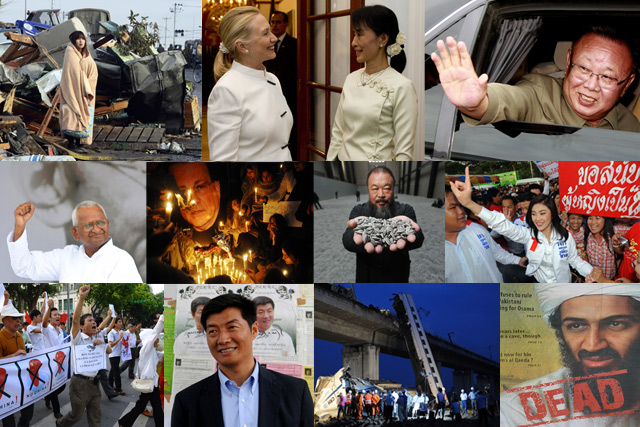
The year 2011 will be remembered as a seminal one of ground-shifting events throughout the world.

In Japan, the shift was quite literal: a giant magnitude-9.0 earthquake triggered a catastrophic tsunami. In the Arab world, the very foundation of long-standing regimes was shaken until a number of its totalitarian leaders fell, and are still falling.

There was the British Royal wedding, swells of anti-Communist Party sentiment in China, and the spread of the Occupy Movement from Wall Street to over 80 countries and counting. So, from revolution across the Arab world to a nuclear disaster in Japan, from the euro zone crisis to a tabloid phone hacking scandal, from Osama bin Laden to Wills and Kate, 2011 was a remarkable year.

See reuters site for more pictures.

And a multimedia showcase of some of 2011's top stories, including Japan's tragic earthquake, the Arab Spring, the demise of Osama bin Laden and Muammar Gaddafi, the shooting rampage in Norway, famine in Somalia and the Royal Wedding. Multimedia editing by Jillian Kitchener.


Here's CNN vidoes of 2011 - Part 1 and Part 2

And in Asia....


And very nice pictures from LIFE magazine.


Friday, December 30, 2011

The Mystery of Qin Shi Huangdi’s Mausoleum

Qin Shi Huangdi, the first emperor of China, was the only ruler who single-handedly unified the seven warring clans of the China of 221 BCE and commanded massive construction of several public infrastructures as well as the legendary Great Wall of China.

His tomb which is seen as the epitome of Emperor Qin Shi Huangdi’s boundless power and prestige is located 30 km to the outside of X’ian in the Shensi province of China.


                       Some of the 7000 Warriors, discovered in 1974. They are guarding the tomb of Emperor Qin Shi Huangdi near Xi’an, Central China. Known as the “Terra-cotta Army”, the Warriors are now considered the 8th Wonder of the World

The emperor left a written record of his military and diplomatic feats in a series of tablets. He successfully abolished feudalism, promoted religion and divided China into 36 states for an efficient administration. Among the other significant achievements of Emperor Qin Shi Huangdi was the standardization of various systems of writing, weights and measures, currencies and the simplification of the record-keeping methods. Despite these progressive works, Qin Shi Huangdi was despotic and tyrannical in his rule.

Interestingly, this great builder ordered the erection of his burial chamber right after his ascension to the throne in 246 BCE when he was just a boy of thirteen! Going by the records about his personal traits, it was rather a contradictory step for Qin Shi Huangdi to take because of his search for an immortality formula to help him eternalize his ‘divine rule’. However, the work completed 36 years after it was started and Qin Shi Huangdi died soon after in 210 BCE to be buried in it.

The discovery of this archeological treasure happened in 1974, when a team of Chinese peasants abruptly came across the tomb while trying to drill a well. What was most striking about this mausoleum was its huge size and the remarkable artworks stored in it. This includes the 8000 life-size army consisting of terracotta statues of men and horses. Because each statue was individually built with 3-inch thick terra-cotta clay, you can distinguish each soldier and horse from another in their unique looks, weaponry and dressing.

The warriors are positioned according to the ranks they held in the contemporary time. The different sections of the 8000 troops are distributed in three separate chambers. The first and the largest chamber contains the troop of active duty officers, the second chamber is where the reserves are placed while the third small chamber houses 68 elite commanders and officers. All the soldiers face east to protect the afterlife of Qin Shi Huangdi from possible enemy attacks coming from that direction.

The mystery of this tomb lies in the fact that the three-chamber terracotta soldier complex forms only 1% of the total mausoleum area. The central section of the 90-feet tall mausoleum building beneath an earthen pyramid is still unexcavated. According to the accounts of Chinese historians and popular legends, this part is mapped as a city, with walls, palaces and cemetery and meant for the use of Qin Shi Huangdi in his luxurious afterlife. The rivers and water bodies are sketched with flowing mercury while the sky is represented by constellations of pearls.

The underground palace is arguably the most elaborate structure in its grandeur and amenities. It could be an abode of long-buried treasures like precious gems, metals and other wealth. This intricate bronze-lined, waterproof construction extending over four square miles took the labor of 700,000 prisoners of war and slaves for its completion after which they were killed to stop them from divulging the tomb’s secret. To make Qin Shi Huangdi’s second life as pompous as his life on earth, his mistresses were buried alive in this tomb as well.

Even today the excitement over the mysterious secrets of this sophisticated necropolis has not stopped drawing groups of tourists and intellectuals from the world over. As a tourist, you can freely take a tour to the spot although all the details of its excavations are strictly under Chinese authorities. They are still to dig out treasures and valuables from the womb of Qin Shi Huangdi’s mausoleum. Only when the tomb is opened up completely, the myriad marvelous accounts it has commanded will meet the light of truth.


Wednesday, December 21, 2011

Q Confucius in Rockbund Art Museum, Shanghai - by Zhang Huan

The Rockbund Art Museum (RAM) re-opens in Shanghai on October 15, 2011, after completing Phase II of the historical building’s renovations. The first exhibition will be Q Confucius, a solo exhibition by world renowned artist Zhang Huan.

This is the largest solo exhibition in China by world-renowned artist Zhang Huan. With Confucius as his inspiration, the now Shanghai-based artist explores the impact on art, society, and religion of China’s rapid economic, cultural, and environmental changes. All new work has been commissioned specifically for RAM’s exhibition featuring animated large-scale sculptures, paintings, ash paintings and installations. Zhang Huan: Q Confucius, guest curated by Fumio Nanjo, Director of Mori Art Museum, Tokyo will be on view from October 15, 2011 – January 29, 2012, accompanied by a catalog and a series of talks and panel discussions.

Q Confucius originates from a series of questions Zhang Huan posed about the future:


Faced with rapid economic and societal changes and energy, climate, and environmental challenges, how can human beings achieve sustainable and harmonious development and restrain from rapacious plunder? 


What responsibilities come with China’s rise in international prominence and power; and how do we build a new international order in politics, economics and culture? 


Where is the sense of spiritual belonging for contemporary Chinese – should there be a return to tradition, a closer alignment to the west, or something new? 


Though these questions seem immense and unrelated, Zhang Huan finds them to be critically interconnected and hopes the exhibition will provide a structure to observe, reflect, and instigate discussion. 


Using Confucius as a symbol throughout the exhibition, the artist provides a context for the questioning of spirituality in contemporary China, contrasting the Chinese spiritual leader’s beliefs with the teachings of Jesus and other religious beliefs. 


Q Confucius as seen below shows the enormous bust of Confucius. It rises from the water and "breathes" mechanically and with accompanying audio, makes one reconsider today's "materialistic China". One can't help but wonder what the wise old sage would say were he to return, and what the role of Confucianism should be in today's China.


So when in Shanghai, do drop by to see this wonderful piece of art. Exhibition is on till 29 Jan 2012.


About Shang Huan ( His website )

From the beginning of Zhang Huan's career, as one of the first wave of Chinese performance artists active on the Beijing scene in the 1990s, he never failed to make an impact. Though he has not been a favourite of authorities, being reprimanded more than once for the perceived “inappropriateness” of his artistic performances, Zhang won the attention of art fans around the world with his visceral and masochistic performances.
Using his body as a medium, Zhang has chained his naked self from the ceiling of his apartment and slowly dripped his own blood into a metal bowl in a piece called '65 Kilograms'. He also, famously, slathered his body in honey and fish oil before sitting nude in a fly-infested, stench-filled public toilet in '12 Square Meters'. 
“No one can escape cruelty, neither myself, nor the audience,” Zhang Huan said early in his career. “Once the audience members step into the site of the performance, they become involved in the reality before their eyes. They have nowhere to escape, just as they have no way to escape reality.”
After moving to New York in 1998, Zhang Huan's performances increased in complexity, and were often composed of several parts. According to the artist, this progression was a necessary response to his increasingly complicated relationship with the world as a Chinese artist living, working and travelling in the West.
“In China, I was doing things for myself. Now people invite me to perform, to become a cultural event. I have a job to do,” Zhang said. “I try to understand each new situation. I combine impressions of China with local culture, what people call glocal. It's about going from one place to another, and bringing what you have to offer to each new place. Sometimes I understand the experience, sometimes not.”
In later years, Zhang has moved back to China and now bases himself in Shanghai, where he has reinvented himself as a painter, sculptor and installation artist. Spirituality, particularly in the Buddhist context, has become a prevalent theme in his work.
According to RAM's deputy director, Liu Yingjiu, the museum has been interested in featuring an exhibition of Zhang's new works since before the museum was inaugurated in 2010. The parties went back and forth with proposals, and the artist developed ideas for two years before they came up with the 'Q Confucius' incarnation, which will be Zhang's largest solo show in China to date and won't be featuring either foul smells or the artist's blood.
With Confucius as his inspiration, Zhang examines the impact of China's rapid development on the country's art, society and religion. Featuring all new works commissioned specifically for this exhibition, a variety of mediums – including animated large-scale sculptures, paintings, ash paintings and live animal installations – will be on show.
“The idiosyncratic elements of these materials will bring striking visual and intellectual tension to the audience, and in the meantime, its emotional power will be communicating with the spiritual subject of the exhibit, which will be alluring and thought-provoking,” Liu says.
One of the major themes Zhang uses Confucius to explore is whether there is (or should be) a sense of spiritual belonging in contemporary China. By contrasting the traditional Chinese spirituality with the teachings of deities from around the world, he asks whether China should return to its roots, look west for spiritual inspiration, or turn in a completely new direction.


Thursday, December 8, 2011

Qing ming Shanghe Tu - A Moving Masterpiece

Qingming Shanghe Tu is a Panoramic Chinese scroll painting by Zhang Zeduan. Literally, qingming 清明 means “clear-bright,” and shanghe tu 上河圖 means  “going-along-the-river-picture.” Another possible translation of the scroll’s name is  “Spring Festival,” referring to the Qingming festival when, in early spring, the  living sweep the graves of their ancestors. 


An 18th century remake is shown in the video below. However, you can see the 12th century scroll in this site or here


Introduction

... In 1954 Chinese scholars announced the discovery of a previously unknown scroll in the Beijing Palace Museum, where it had been returned from Manchuria after World War II. It was entitled Qingming shanghe tu 清明上河圖. Most scholars now accept this as the earliest extant version of the scroll ... and date it to the twelfth century.

The Handscroll Format

The Beijing scroll is a handscroll measuring 25.5 centimeters (10.03 inches) in height and stretching 5.25 meters (5.74 yards) in length, done in monochrome ink on silk. The original has faded to a warm brown with a few details — like the green buds of willows — in color.  Although the scroll is over eight hundred years old, it is in surprisingly good condition, with only a few patches and many fine vertical cracks along the grain of the silk.

Even though modern museums often display handscrolls stretched out full-length under a glass case, they were originally intended to be held by the viewer, who would unroll only an arm’s length section at a time. Starting at the right end of the scroll, and progressing to the left, the viewer determined the pace. The Beijing scroll includes many moments of suspense to entice the viewer to keep on looking. Because, with the use of perspective, the artist can make something seem to come closer and then to recede, a handscroll can show the same object from different angles. The Beijing scroll often employs an overhead perspective, as if one is watching the people and activities from above — standing on a city wall perhaps — but occasionally the artist dramatically shifts his angle of vision. In the center of the scroll, the artist first paints the underside of the central bridge and then draws back to depict the many people and shops on top of the bridge. ...


In the 5.28-meter long picture, there are 814 humans, 28 boats, 60 animals, 30 buildings, 20 vehicles, nine sedan chairs, and 170 trees drawn. The countryside and the densely populated city are the two main sections in the picture, with the river meandering through the entire length.
The right section is the rural area of the city. There are crop fields and unhurried rural folk—predominately farmers, goatherds, and pig herders—in bucolic scenery. A country path broadens into a road and joins with the city road.
The left half is the urban area, which eventually leads into the city proper with the gates. Many economic activities, such as people loading cargoes onto the boat, shops, and even a tax office, can be seen in this area. People from all walks of life are depicted: peddlers, jugglers, actors, paupers begging, monks asking for alms, fortune tellers and seers, doctors, innkeepers, teachers, millers, metalworkers, carpenters, masons, and official scholars from all ranks.


Digital version
For a three month period in the World Expo 2010 presented at the China Pavilion, the painting was remade into an 3D animated, viewer-interactive digital version, titled River of Wisdom, about 30 times the size of the original scroll. The computer animated mural, with moving characters and objects and portraying the scene in 4-minute day to night cycles, was one of the primary exhibitions in the Chinese Pavilion, drawing queues up to two hours with a reservation. Elaborate computer animation gives life to in the painting.
After the Expo, the digital version was on display at the AsiaWorld-Expo in Hong Kong from November 9 to November 29, 2010, where it was a major commercial success. It was then exhibited at theMacau Dome in Macau from March 25 to April 14. The digital painting also traveled to Taiwan and displayed at the Expo Dome in Taipei from July 1 to September 4, 2011. From December 7, 2011 to February 6, 2012, under the exhibition titled A Moving Masterpiece: The Song Dynasty As Living Art, the painting is being exhibited at the Singapore Expo from 7 Dec2011 to 8 Feb 2012...

Hence, I took the opportunity to see the digital version of this grand masterpiece at the Expo in Singapore.  The digital version has been seen by more than 10 million people.

First, there is the Pre-Show Hall which shows:

• An immersive experience of the Song Dynasty and the elements that make it a vibrant capital city
• Learn about the achievements of this ancient Global City, its innovations and their relevance today
• Explore the urban lifestyle of the Song citizen – from festivals and celebrations, to recreation and leisure activities

If you are interested to learnt more about the urban life of the people during the 12th century Song Dynasty, refer to this document from Yale University.


 A Scholar Returns to his Village

Importance of the 5 Elements: Fire, Earth, Wood, Water, Gold


The digital version has taken 2 long years to convert. The creators of the digital version of Qing Ming Shang He Tu, which is 30 times larger than the original, are Crystal CG Shanghai, one of China’s leading companies in digital technology. 

Crystal CG Shanghai’s director, Yu Zheng, says: “It was a mind-blowing experience to re-create this work of art, which every Chinese person is familiar with. My team and I felt enormous pressure to make sure we could do justice to the original. In the end, we are very proud of the final product as it brings a whole new dimension to appreciating the original. It also makes the artwork relevant to a new generation of younger tech-savvy audiences.”


And some panoramic here views captured from my Sony camera.


You can see the animated digital version of the painting in the 2 videos below with nice Chinese music. Amazing !!


The wooden bridge (the center piece of the painting) depicted in the original version would later be rebuilt by a team of engineers and documented by the PBS television show NOVA during their Secrets of Empire series.  You can see how they try to reconstruct the bridge.


Wednesday, October 26, 2011

A Simplified History of China

Today is Deepavali and I wish all Hindus and Indians a very happy Deepavali. It is a public holiday in this part of the world and I have been trying to do some useful reading. One of the top on my list articles to read is the history of China. With such a long and complicated history, I usually do not have the time and patience to read those long articles on this subject.

Today I came across this website which gives a brief history of China, I find it useful and hope it would benefit you as well. The first 2 paras of the article is given below.


" Homo erectus fossils ("Peking Man", nowcalled "Beijing Man" in China) have been found in the cave-ridden hills of Zhoukoudian (50 kilometers southwest of Beijing) which are an estimated 680,000 to 780,000 years old. Agricultural civilization began in China as early as 8,000 BC with the cultivation of millet & rice around the Yellow & Yangtze Rivers, respectively. Settlements along the Yangtze began to use silk and produce art having dragon motifs around 3,500 BC. Finely carved jade (a symbol of wealth and power in China comparable to gold in the West) first appeared around the Yellow River around 3,500 BC.
The first known Chinese dynasty was that of the Shang, which began in northeastern Hunan and later extended eastward along the Yangtze to the sea. Shang warriors used horse-drawn chariots. Various city-states served as capital during the 500 or so years of the dynasty. Religion was based on reverence for ancestors, heavenly bodies and a supreme god who dominated the forces of nature. Royalty have been found buried with their valuables, including servants who were buried alive. The invention of Chinese writing is associated with Shang, which would explain why the Shang is the first dynasty for which there is a written record."
 Invention of Chinese Writing
 Symbols were carved on oracle bones and tortoise shells

Popular Posts